Guide · Broadhead tuning

Broadhead tuning a compound bow

The last step before hunting season. How to make broadheads hit alongside field points, what to adjust when they don’t, and when the problem is upstream of the rest.

What broadhead tuning is

Broadhead tuning is the final aerodynamic check on a compound bow. You shoot a group of field points and a group of broadheads at the same aim point, read the offset between the two groups, and make small mechanical corrections to the rest, nock point, and (when needed) cam lean until the groups converge.

The reason it’s needed is geometry. A field point has almost no aerodynamic surface — it does very little to expose a flawed launch. A fixed-blade broadhead has an inch or more of exposed blade acting like fletching at the front of the arrow. Any yaw, pitch, or sideways flex on launch gets amplified by those blades and steers the arrow off-axis in flight. A bow can produce a clean paper tear at 6 ft while still flying broadheads four inches off at 40 yd — the field points hid what the broadheads now reveal.

What broadhead tuning does not do: it doesn’t fix a spine mismatch, it doesn’t fix a bent broadhead, it doesn’t fix fletching contact, and it doesn’t fix a torqued grip. The rest is a micro-adjustment around an otherwise well-built setup. If you’re tuning to mask one of those problems, you’ll spend the rest of the season chasing it.

Before you start

The single most common reason broadhead tunes go sideways is that something upstream of the rest is wrong. Run these checks first — the order matters.

Paper tune comes first

A clean bullet hole at 6 ft is the predicate. Broadhead tuning is the validation step, not the primary tool. If your paper tear isn’t clean, fix that before you put a broadhead on a shaft. Many tuners run a bareshaft pass between paper and broadhead; it’s optional on a compound but valuable on borderline-spine setups.

Square the arrow ends

Cut ends are rarely flat. Use an arrow squaring device (G5 ASD, Pine Ridge Arrow Inspector) on both the nock end and the insert end after cutting. An out-of-square insert tilts the broadhead off-axis even when the head itself is perfect, and produces the classic “one flier per group” pattern that no rest adjustment fixes.

Spin test every broadhead

Thread each broadhead onto its arrow and spin the assembled shaft on the broadhead tip — on bearings, on a flat surface, or with a dedicated spin tester. Acceptable runout is visually imperceptible wobble. If you can see the tip orbit, rotate the head 120° and retry. If it still wobbles, swap the head. If a different head wobbles on the same shaft, the insert or shaft is bent. This is per-session, not per-build — every install can seat slightly differently.

Match weight within 2 grains

Field points and broadheads should weigh the same to within 2 grains. A 5–10 grain mismatch shifts impact vertically and weakens dynamic spine on the heavier side, opening up horizontal drift too. SEVR sells half-grain-matched field points; Easton’s deep-six and match-grade field points are also common picks.

Identical fletching, identical setup

Both the field-point arrows and the broadhead arrows must be fletched the same way — same vane size, same helical/offset, same jig. Fletching is part of the tune. The conventional hunting setup is 2″ low-profile vanes with 2–3° of helical; helical rotation is non-negotiable for fixed-blade stabilization.

Sight in with field points first

Build your sight tape with field points to a known point of aim, then validate with broadheads. Never the other way around. Moving the sight to chase broadheads is the most common bad advice in archery — it hides the tuning error and produces an arrow that plane unpredictably at distance.

Form, calm air, real conditions

Broadheads amplify form noise. Death-grip, plucked release, inconsistent anchor — all show up four inches wide at 40 yards. Shoot in calm air; a 5-mph crosswind moves a fixed-blade head enough to confound the read. Indoor lanes are fine for diagnosis; outdoor confirmation in real conditions is mandatory.

Reading the result

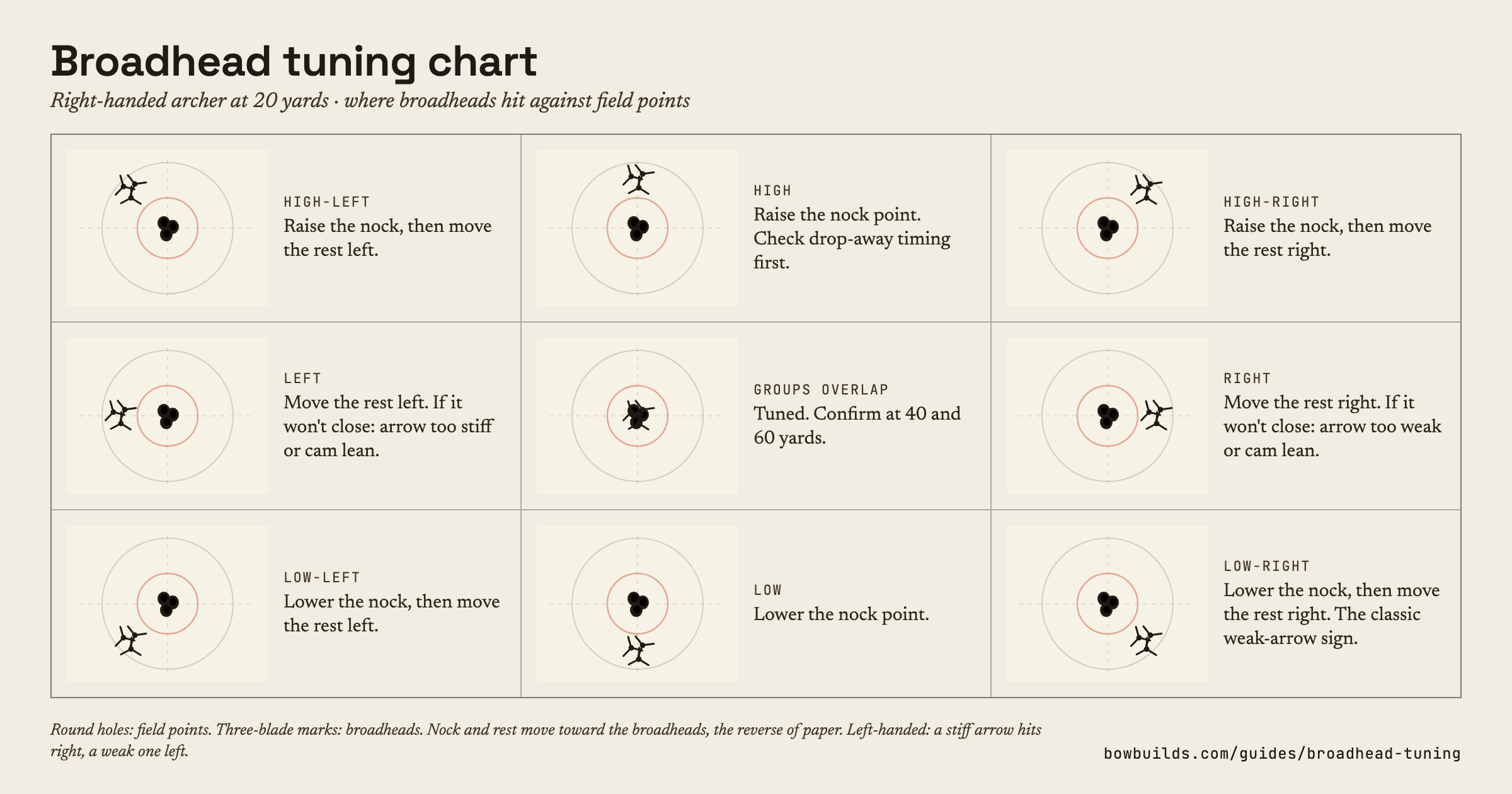
Stand 20 yards from the target. Shoot a 3-arrow field-point group, then a 3-arrow broadhead group, at the same aim point. Confirm each group is tight on its own — a scattered broadhead group is a hardware problem and won’t respond to tuning. Once both groups are tight, read the offset between them.

The patterns below are written for a right-handed archer. Left-handed archers see the same vertical reads but the horizontal reads flip — a right-hand underspine signature (broadheads right) becomes a left-hand overspine signature, and so on.
Groups overlap

Broadhead and field-point groups in the same hole or within an inch of each other. The target state. Confirm at 40 and 60 yards before declaring victory; re-confirm after string break-in (roughly 200 shots on factory strings, 30–50 on premium aftermarket).

Broadheads left of field points (RH)

Three possible causes, in order of likelihood. Overspine — arrow too stiff for your draw weight and point load; the shaft flexes too little and drives left off the rest. Rest too far inboard (toward the riser) — a micro-adjustment outboard closes it. Top cam leaning right — diagnose by sighting down the string at full draw, fix with yoke twists or a cam shim. Differentiate by trying a heavier point: if impact moves right, you were overspined.

Broadheads right of field points (RH)

The mirror, and the more common modern problem given heavier broadhead weights and shorter shafts. Underspine — arrow too weak. Rest too far outboard. Top cam leaning left. Try a lighter point to confirm underspine; impact moving left tells you spine was weak.

Broadheads high of field points

Incomplete vertical paper tune (residual nock-low tear) or a mistimed drop-away rest falling before the arrow has cleared. The arrow launched tail-low and pitched up in flight. Check drop-away timing before adjusting the nock.

Broadheads low of field points

The opposite — residual nock-high launch error or a nock set too high on the string. Less common than the high case because most paper tunes resolve nock-high before nock-low.

Combination offsets

High-left, high-right, low-left, low-right. Diagnose vertical and horizontal independently and fix vertical first — vertical launch error can mask or amplify the horizontal read. Low-right on a RH setup is the classic underspine signature.

Scattered broadhead group

The bailout case. If the broadhead group is loose (4″+ at 20 yd with no clear center), you don’t have a tuning problem. Causes, in rough order: a bent broadhead ferrule, an out-of-square insert, fletching contact, form breakdown, spine far off, or a previously-impacted broadhead with damaged geometry. Spin-test every shaft, re-square the inserts, swap in known-good heads. Don’t move the rest.

Severity, roughly (at 20 yards)

  • Under 1″ — within group-spread overlap. Leave it; the bow shoots broadheads to point of aim.
  • 1–2″ — tunable in one or two rest moves. The bread-and-butter case.
  • 2–4″ — tunable, but indicates an upstream issue (cam lean, marginal spine, runout). Tune carefully and re-check assumptions.
  • Over 4″ — don’t chase with the rest. Go back upstream.

Fixing the offset

Vertical: nock point, then rest

Broadhead high → raise the nock point (the arrow launched tail-low and pitched up). Broadhead low → lower the nock. The rule inverts from paper tuning: on paper the tear shows the launch geometry directly, but broadheads show what the arrow did downrange after the launch error pitched it.

Prefer the nock over the rest for vertical fixes — moving the nock doesn’t disturb centershot geometry. The rest is available if nock travel runs out. Increment: 1/16″ at the nock.

Horizontal: chase the broadhead with the rest

Broadhead left → rest left. Broadhead right → rest right. The rest moves in the same direction as the broadhead offset. This is the most-confused rule in archery because it’s opposite of how sights work, but it’s unambiguous: moving the rest left changes the launch angle so the next arrow leaves with less rightward yaw, which moves the broadhead group right toward the field points. Increment: 1/32″, drop to 1/64″ when you’re within an inch of impact match.

When the rest runs out

If you’ve moved the rest more than ~1/8″ from centershot to chase the broadhead, stop. You’re now masking a cam-lean problem with rest position, and you’ll pay for it at distance. The rule of thumb: rest is the micro adjustment, cams are the macro adjustment. Past 1/8″ of travel, switch to the cams.

Cam lean — yoke tuning

On yoke-equipped bows (most Hoyts, some Bowtech, Elite, PSE), twist the yoke leg on the side the broadhead is missing toward. Broadheads hitting right → add twists to the right yoke leg (or remove from the left). Broadheads hitting left → opposite. Work in two-twist rounds. Add and remove in equal amounts to preserve cam timing and axle-to-axle spec.

Cap: don’t exceed roughly 6 twists per leg beyond the as-built state. Past that, cable-length divergence affects timing and ATA spec, and you’re no longer correcting cam lean, you’re building cable problems.

Cam lean — binary cams without yokes

Most modern Mathews binary cams have no yoke to twist. Correction is via cam shimming — small “top hat” spacers on each side of the cam axle. The bow is pressed, axle removed, thicker shim swapped onto the side opposite the desired cam move. Shim cams away from the broadhead miss: a left miss means shimming cams right. Top hat kits are roughly $50 from a Mathews dealer; the process is iterative. Newer Mathews (Top Hat 2.0, 2022+) and Bowtech (Deadlock, SET cams) allow shimming without pressing.

Spine, the last suspect

When neither rest nor cam closes the gap, the arrow is wrong for the bow. Persistent broadhead-left on a RH setup that doesn’t respond to anything is the overspine signature; persistent broadhead-right is underspine. Fixes:

  • Overspine (broadheads left, RH): heavier point (e.g., 100 gr → 125 gr softens dynamic spine measurably), or a longer arrow, or a weaker shaft.
  • Underspine (broadheads right, RH): lighter point, shorter arrow, or a stiffer shaft.

Re-run the Easton Shaft Selector or Victory Spine Calculator against your current draw weight, draw length, point weight, and arrow length. A new shaft is sometimes cheaper than three more weekends of chasing the same drift.

The discipline rule

Shoot three, then adjust. Never adjust on a single arrow. Three arrows minimum per side, average the group center, then move one variable. Single-arrow tuning chases form variance, not the bow.

Common mistakes

  • Tuning with broadheads you didn’t spin-test. Every install is a new chance to misalign.
  • Tuning at 10 yards. Fixed-blade behaviour doesn’t express cleanly inside 20.
  • Moving the sight to make broadheads match field points. The all-time worst advice — hides the launch error and produces unpredictable flight at every other distance.
  • Shooting one broadhead and one field point. Single arrows aren’t groups. Three minimum per side.
  • Different vane size, helical, or fletching jig between the broadhead arrows and the field-point arrows. The fletch is part of the tune.
  • Tuning into a crosswind. A 5-mph cross at 40 yd moves a fixed blade visibly.
  • Skipping the paper-tune pre-req and going straight to broadheads.
  • Conflating mechanical-broadhead and fixed-blade behavior. A bow that flies mechanicals well can be miles off with fixed.
  • Confirming at one distance only. 20 and 40 minimum; ideally 60.
  • Re-tuning before checking broadhead integrity. Bent ferrule, loose blade screws, damaged tip — fix hardware before bow.
  • Changing two variables at once. You can’t credit the fix.
  • Mixing arrow shafts or point weights mid-session. Tune one arrow build at a time.

When broadhead tuning isn't enough

If three rounds of broadhead adjustment haven’t closed the gap, the problem is upstream of the rest. Escalate in this order.

Re-verify string condition

Strings creep — peep rotation, ATA shrinkage, draw-length growth. New strings settle in roughly 200 shots on factory rigs, 30–50 on premium aftermarket. A bow tuned with green strings stops being tuned once they finish settling.

Re-paper tune

A clean broadhead tune that started from a marginal paper tune sometimes reveals itself here. Pull the broadheads, re-check the paper tear, fix what you find.

Long-range group tune

Move to 50–60 yards and shoot two groups of three with each point type. Patterns that didn’t show at 20 will be obvious at distance. This is also where you catch fletching that’s too small to stabilize fixed blades.

Suspect the spine

If point-weight changes don’t shift impact correctly — or shift it the wrong way — your spine is wrong for the setup. Re-run the spine selector and consider a different shaft. This is the cheapest fix if you’ve been chasing the same drift for three weekends.

The three-rounds rule

If broadheads don’t tune in three discrete adjustment rounds, stop adjusting. The problem isn’t the rest. Go upstream: spine, cam lean beyond yoke authority, form, rest hardware.

Standard tune order

Contact check → paper → bareshaft → walkback → broadhead → long-range groups.

FAQ

How far should I be from the target when broadhead tuning?
Start at 20 yards. Confirm at 40. Validate at your max ethical hunting distance — 50 or 60 yd is typical. Some authorities (Levi Morgan, Nock On) tune primarily at 40+ because patterns express more cleanly there; others (Easton) start at 20. Either is defensible; the consensus is that one distance is never enough.
Do I need to broadhead tune if I shoot mechanicals?
Less critical, but not skippable. Mechanicals close in flight and have a small frontal profile, so they mask launch errors that fixed-blade heads expose. A bow that flies mechanicals well can still shoot fixed blades 4 inches off at 40 yards. If you hunt fixed, tune for fixed. If you hunt mechanicals only, verify the groups match — they usually will on a paper-tuned bow.
My mechanicals fly with field points but my fixed blades don't. Why?
Your bow has a tuning issue the mechanical's reduced in-flight profile hides. Fixed blades are the diagnostic — they don't lie. Tune the bow with fixed-blade heads; mechanicals will follow.
How tight does the match need to be for hunting?
Within 1 inch at 20 yards is the practical hunting tolerance — that's group-spread overlap and means broadheads will hit point-of-aim at any realistic hunting distance. Inside 2 inches is tunable in one or two rest moves. Past 2 inches and you should suspect an upstream issue (cam lean, marginal spine) rather than chase it with the rest.
Do broadhead-tuning directions flip for left-handed shooters?
Yes. All horizontal diagnoses invert. A broadhead hitting right of the field-point group on a left-handed setup is the underspine / outboard-rest case (the mirror of the RH version). Vertical reads, sequence, and spine logic are unchanged.
Should I use a fresh broadhead per group, or shoot the same one repeatedly?
For tune diagnosis, one known-good head shot repeatedly is fine — it isolates the bow from broadhead variance. For final confirmation, rotate through your hunting set so each head sees impact and any flier head reveals itself. Spin-test every head before either.
What target should I shoot into?
Foam targets rated for broadheads. The Rinehart 18-1 is the consensus pick — self-healing, durable, replaceable core. Bag targets are field-point only; never shoot broadheads into a bag. Glendel and Black Hole work but chew up faster under fixed blades.
I tuned at 20 yd but the groups diverge at 40 yd. What's happening?
Three usual suspects. Marginal cam lean or centershot — a small angular error at the riser integrates into visible separation at distance. Individual broadhead runout — spin test every head. Speed-limited drag divergence — slower setups can't keep fixed blades grouped with field points past 40; the fix is more helical fletch or a smaller, faster broadhead.
Does string break-in matter?
Yes. Strings creep — peep rotation, ATA shrinkage from spec, draw-length growth. Plan to re-tune after about 200 shots on factory strings or 30–50 shots on premium aftermarket. If you tuned with green strings, the tune is no longer valid once they settle.
Does cold weather change the tune?
Yes. Sub-freezing temperatures stiffen limbs and cables and increase air density. The combined effect can move impact 1–2 inches at 40 yards. Re-verify in conditions you'll hunt in — a summer-tuned bow needs a cold-weather check before opening day.
Can I move my sight to make broadheads hit point of aim instead of tuning the bow?
No. This is the single worst piece of advice in the sport. Moving the sight masks the underlying launch error — the arrow still flies sideways, it just hits the spot you're aiming at at one specific distance. At any other distance, it'll be off. Tune the bow.
I can't get broadheads to match no matter what I adjust.
Stop after three rounds of adjustment. The problem is upstream: marginal spine, cam lean beyond yoke authority, form, or rest hardware. Re-run a spine selector against your draw weight and point weight. Re-check cam lean against the cam grooves. Re-check fletching contact. Sometimes the cheapest fix is a different shaft.
Do I sight in before or after broadhead tuning?
Sight in with field points first to give yourself a known reference point of aim. Build the final sight tape after broadhead tuning, with your hunting arrow and broadhead, so the tape is calibrated to what you'll actually shoot.
Can I broadhead-tune a recurve or traditional bow the same way?
No. Traditional bows don't have a micro-adjust rest. Tune via spine selection, point weight, brace height, and nock height — bareshaft tuning is the primary method. Broadheads follow the bareshafts if the bareshafts are correct.

Glossary

Broadhead
The bladed hunting point that replaces a field point. Fixed-blade: blades permanently exposed (Iron Will, Magnus). Mechanical / expandable: blades deploy on impact (Rage, SEVR). Hybrid: fixed primary blade plus deploying bleeders (Slick Trick Magnum, Grim Reaper hybrid).
Field point
Solid practice point matched in weight to the hunting broadhead. The reference point of impact every broadhead tune is measured against.
Spine
Arrow shaft stiffness. Static spine is the AMO-spec deflection of a shaft under a fixed load (500 = 0.500″ deflection at 1.94 lb across 28″). Dynamic spine is the arrow’s actual flex behavior at launch, given your draw weight, draw length, point weight, shaft length, and cam aggressiveness.
Cam lean
Side-to-side tilt of the cam at full draw, caused by uneven cable tension. Produces persistent horizontal broadhead drift that no rest adjustment fully fixes.
Yoke
Split cable terminating at two points on the cam axle. Twisting one leg vs the other corrects cam lean. Present on most Hoyts; absent on most modern Mathews binary cams.
Centershot
Lateral position of the arrow relative to the bowstring centerline. Typical spec around 13/16″ from the riser face. The reference position rest adjustments are measured from.
Spin test
Rotating the fully assembled arrow on the broadhead tip — on bearings or a flat surface — to visually detect wobble. Confirms broadhead, insert, and shaft are coaxial. Per-session, not per-build.
Insert / outsert
Internal sleeve (insert) or external sleeve (outsert) glued into the front of the shaft that the broadhead threads into. An out-of-square insert is a top cause of scattered broadhead groups.
Arrow squaring device
Small abrasive tool (G5 ASD, Pine Ridge Arrow Inspector) that grinds the shaft end perpendicular to the shaft axis. Used on both nock and insert ends.
FOC
Front of center — percent forward shift of the arrow’s balance point from the geometric center of the shaft. Hunting consensus is 10–15%; “extreme FOC” advocates push 18–25%.
Helical / offset fletch
Angular alignment of vanes on the shaft. Offset keeps vanes parallel to the shaft but rotated around the axis; helical twists vanes into a slight spiral. Helical imparts more rotation and is essential for fixed-blade stabilization; standard hunting setup uses 2–3° of helical.
Walkback tuning
Group tune at progressively longer distances (20, 30, 40, 50, 60) against a vertical reference. Diagnoses left-right rest position across distance.