Paper tuning a compound bow
A practical reference. How to read every tear, what to adjust, and when paper alone isn't enough.
What paper tuning is
Paper tuning is a diagnostic. You shoot a fletched arrow through a vertically suspended sheet of paper at close range and read the shape of the tear. The tear tells you the attitude the arrow is flying at — whether it's leaving the bow point-first and straight, or fishtailing or porpoising because something in the system is misaligned.
On a compound, a clean tear (a bullet hole) is achievable and meaningful. Compound cams release the string in roughly a straight line, so the archer's paradox that recurves contend with is minimal. A bullet hole means the rest, nock point, cam lean, and arrow spine are all close enough to right that the arrow flies cleanly out of the bow.
What paper tuning does not tell you: whether your sight tape is correct, whether your arrows group well at 40 yards, or whether your broadheads will fly with your field points. Those are downstream checks. Paper is the first pass — fastest signal for the lowest cost.
Before you start
The single most common reason paper tuning goes sideways is that something is wrong with the system before the tuner ever puts paper in front of the bow. Run these checks first.
Eliminate contact
A vane brushing the rest or a cable will produce a tear that no rest or nock adjustment can fix. Spray foot powder, dry shampoo, or rub a lipstick on the rest, the cables, and the cock vane. Shoot one arrow. Check for marks. Rotate the nock 90° and 180° and repeat — vane orientation matters, especially with full-containment rests, blade rests, and tight cable guards.
Confirm centershot
Set the rest to the manufacturer's published centershot before you do anything else. Most major risers use somewhere around 13/16" from the riser face to the center of the shaft, but verify with your bow's manual — Hoyt, Mathews, PSE, Bowtech, and Elite each spec their own starting point. A wrong centershot makes everything else harder.
Drop-away timing
If you shoot a drop-away, confirm the launcher arm is fully up at the moment of release and only falls after the arrow leaves. Mistimed drop-aways produce tail-low tears that look like a nock point problem but aren't. Most rest manuals describe a draw-board test or a piece of dental floss used to verify timing.
Form, then everything else
Inconsistent form produces inconsistent tears. If your three-shot reads disagree with each other, no amount of mechanical tuning will help — the bow is fine; you're not. Fix the form first, then tune.
Reading the tear
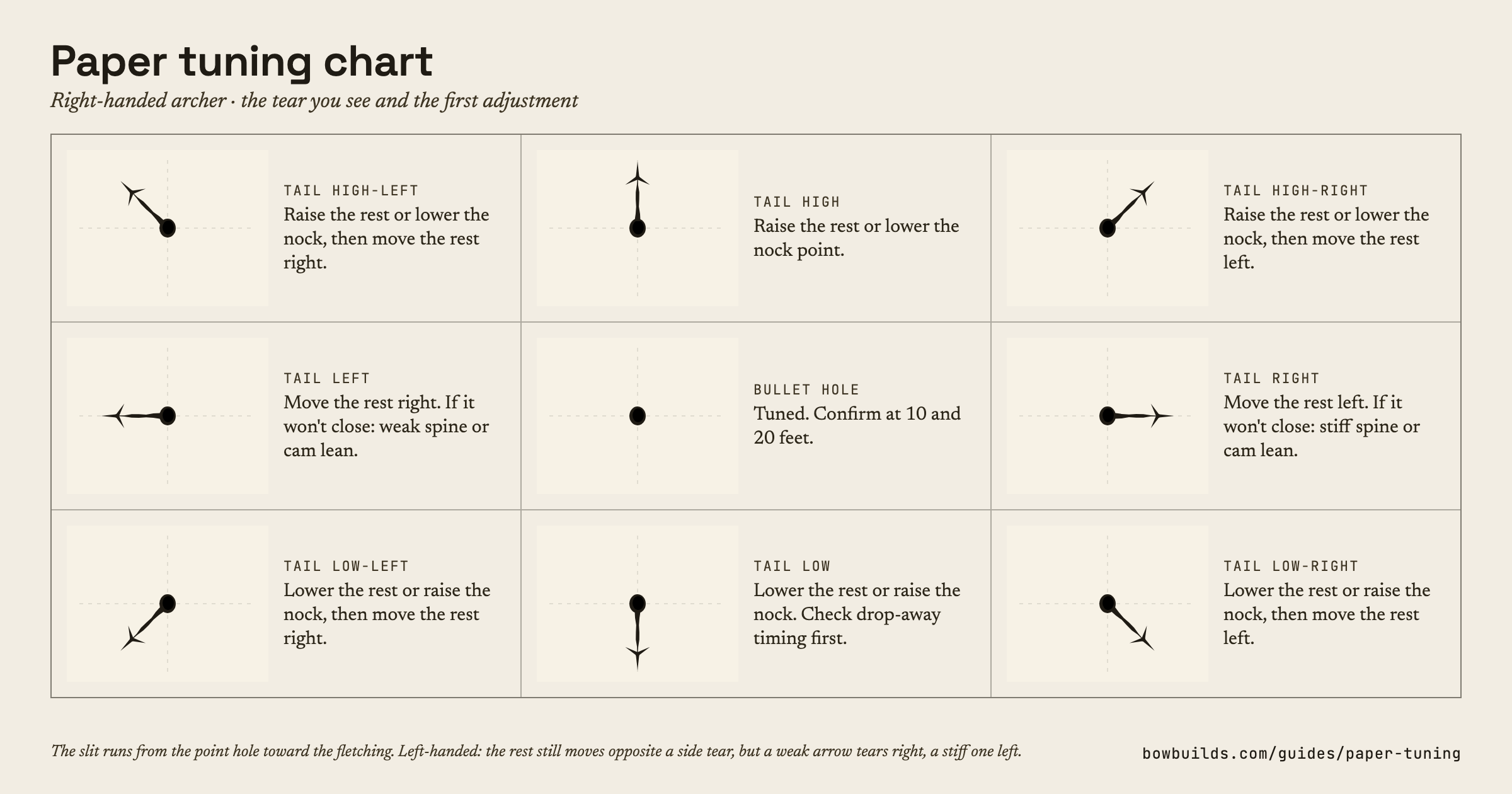
Stand about 6 feet from the paper and shoot three arrows. The tear shape is the fletching slits relative to the point hole — read the offset, not the absolute position on the paper. Some tuners start closer (2-4 feet) for an exaggerated first read; either works as long as you confirm at 10 ft and 20 ft afterward.
The patterns below are written for a right-handed archer. Left-handed archers see the same vertical reads (high is high, low is low) but the horizontal reads flip — what's a weak-spine tear-left for an RH shooter is a tear-right for an LH shooter.
Bullet hole
A clean point hole with three or four fletch slits radiating cleanly from center, no tail offset. The target state. Confirm at multiple distances and move on.
Tail-high
The fletching end of the tear sits above the point hole. Indicates the nock point is too high relative to the rest, or the rest is too low. Common on fresh setups.
Tail-low
Fletching below the point. Nock point too low, rest too high — or, if you shoot a drop-away, the rest is falling before the arrow has cleared. Check timing before adjusting.
Tail-left (RH)
Fletching offset to the left of the point hole. Three possibilities, in rough order of likelihood: rest too far right (toward the riser), arrow underspined for your draw weight and point load, or top cam leaning right. Eliminate the rest first.
Tail-right (RH)
Fletching offset right. Mirror of the above: rest too far left, arrow overspined, or opposing cam lean.
Combination tears
High-left, high-right, low-left, low-right. Diagnose the vertical and horizontal components independently. Standard practice is to fix vertical first because vertical errors can mask or amplify horizontal reads.
Severity, roughly:
- Under 1/4" tail offset — minor; many hunters consider this acceptable for hunting at typical ranges.
- 1/4" to 1/2" — meaningful; should be tuned out.
- Over 1/2" — significant; likely a real setup problem (contact, spine mismatch, cam lean, or form).
Fixing the tear
Vertical: rest height, then nock point
Tail-high → raise the rest or lower the nock. Tail-low → lower the rest or raise the nock. Both adjustments work toward the same fix; they aren't opposite signs in the way recurve archers are used to. Move one variable at a time so you can credit the change to the right adjustment. Most tuners adjust the rest first because nock points on a serving are harder to fine-tune. Increment: 1/32" for fine work, 1/16" for larger tears.
Horizontal: chase the tear with the rest
Tail-left → move the rest left. Tail-right → move the rest right. The rest moves in the same direction the fletching is pointing. Same 1/32" increments. Reshoot after each change — it's tempting to move twice and check once, but you lose the ability to credit the fix.
When windage runs out
If you've moved the rest as far as it will go and the tear hasn't closed, stop. The remaining problem is one of three things: cam lean, a yoke that needs tuning, or a real arrow spine mismatch. Continuing to push the rest beyond reasonable centershot just masks the real issue and makes everything else harder to diagnose.
Cam lean
Cam lean is side-to-side cam tilt at full draw, caused by uneven cable tension. It produces persistent horizontal tears that windage can't fix. Correction is bow-specific:
- Yoke-equipped bows (most Hoyts, some Bowtech, Elite, PSE): twist one leg of the split yoke to pull the cam toward or away from the shooter. Add twists to the side opposite the lean.
- Non-yoke bows (most modern Mathews binary cams): correct via cable-guard offset or cable adjustments. Mathews publishes a specific timing-and-lean procedure in their tuning guide.
A cam lean gauge makes this faster, but you can also eyeball it by checking that the string at full draw lines up with the cam grooves on both cams.
Spine
A persistent tail-left tear (RH) that doesn't respond to rest movement is the classic weak-spine signature. Tail-right is the stiff-spine signature. Adjust point weight (heavier point softens dynamic spine, lighter stiffens it), arrow length (shorter is stiffer), or shaft selection.
Important caveat: paper at point-blank exaggerates spine reaction because the arrow has barely had time to recover from the launch flex. By 18-20 yards, properly fletched arrows steer most spine-induced tears straight in flight. Don't chase a tiny spine tear at 6 feet if your groups are tight at hunting distance.
Common mistakes
- Tuning through inconsistent form. If three shots disagree with each other, the bow is fine — your release or grip isn't.
- Paper too far away — fletching has steered the arrow back, hiding a real flight problem.
- Paper too close — exaggerated spine reaction makes you chase a tear that resolves on its own at distance.
- Skipping the contact check. A vane brushing the rest produces a tear no adjustment fixes.
- Not indexing nocks. A small nock rotation can shift fletch contact relative to the rest or cables.
- Ignoring cam lean. Pushing the rest past sane centershot to chase a tear caused by cable tension — the rest can't compensate for it.
- Adjusting rest and nock simultaneously. You can't credit the fix.
- Single-shot tunes. One arrow is not data; three is the minimum.
- Tuning with a different arrow than your hunting arrow.
- Forgetting to re-tune after string break-in, draw-weight changes, peep changes, or any arrow change.
When paper tuning isn't enough
Paper is a coarse first pass. A clean tear means the arrow leaves the bow well — it doesn't guarantee it groups well at distance, and it doesn't guarantee broadheads will fly with field points. There's a standard tune order that picks up where paper leaves off.
Bareshaft tuning
Shoot one or two unfletched arrows alongside fletched arrows at 15-30 yards. Compare where the bareshafts impact relative to the fletched group. Bareshafts are far more sensitive to spine and cam lean than paper, so they'll surface problems point-blank paper can hide. Most serious tuners run paper, then bareshaft.
Walkback tuning
Aim at a single dot at 20 yards, then shoot the same 20-yard sight pin at 30, 40, and 50 yards without re-aiming vertically. Impacts should fall on a vertical line. Drift left or right with distance reveals a centershot or windage error that paper at point-blank can't see.
Broadhead tuning
The hunting check. Shoot field points and broadheads at 20-30 yards (some tune at 40+). They should hit the same point. If broadheads steer off the field-point group, micro-adjust the rest in the direction needed to bring the broadheads in. This is the last-stop tune for any hunting setup.
Group / French tuning
Long-range groups at the end. Confirms the system as a whole, including sight, form, and arrow spine, beyond what any single short-range diagnostic catches.
Standard order: Contact check → paper → bareshaft → walkback → broadhead → groups.
Step-by-step
- 1. Eliminate contact issues first. Use a lipstick or foot-powder test on the rest, cables, and vanes to find any interference. Rotate the nock 90° or 180° to confirm vanes aren't striking the rest or cables.
- 2. Set up the paper at about 6 feet. Mount a sheet of newsprint or butcher paper in a tight, vertical frame at chest height. Place a target butt 2-3 feet behind it. Stand roughly 6 feet from the paper for the first read.
- 3. Shoot three arrows from your normal stance. Use the same arrow, anchor, grip, and release you'd use hunting. One shot is not data — three shots tells you whether the tear is consistent or a form artifact.
- 4. Identify the tear pattern. Read the position of the fletching slits relative to the point hole. Tail-high, tail-low, tail-left, tail-right, or any combination — each pattern points to a specific adjustment.
- 5. Fix vertical first. Tail-high: raise the rest or lower the nock point in 1/32" increments. Tail-low: lower the rest or raise the nock. Adjust one variable at a time so you know what's working.
- 6. Then fix horizontal. Chase the tear with the rest: tail-left → move rest left; tail-right → move rest right. Move in 1/32" increments and reshoot after every change.
- 7. Investigate cam lean or spine if windage runs out. If you can't tune out a horizontal tear with rest movement alone, suspect cam lean (correct via yoke twist on yoke-equipped bows, or cable-rod offset on others) or arrow spine mismatch (adjust point weight, arrow length, or shaft).
- 8. Confirm at multiple distances. Re-shoot at 10 ft, then 20 ft. The tear should stay clean or improve. A clean tear at 6 ft that worsens at distance points to spine or fletching contact you didn't catch.
FAQ
- How far from the paper should I stand?
- About 6 feet is the most-cited starting distance. Some tuners start as close as 2-4 feet for the first read because the fletching hasn't yet steered the arrow back to straight. Either way, confirm at 10 ft and 20 ft — a clean tear should hold.
- How perfect does the tear need to be for hunting?
- Most hunters consider a tail offset under about 1/4 inch acceptable, especially if your broadheads group with field points at hunting distance. A perfect bullet hole is the ideal but not always achievable, and the difference between 1/4" and 0" rarely matters at 30 yards.
- Do paper-tear directions flip for left-handed shooters?
- Vertical reads are the same — tail-high is tail-high regardless of handedness. Horizontal flips: a left-handed archer's weak-spine signature is tail-right, and stiff-spine is tail-left. The "chase the tear with the rest" rule still applies.
- Why did my tear change after another 50 arrows?
- Strings and cables creep, especially in the first 200 shots after a new string. Creep changes axle-to-axle length, brace height, cam timing, and peep rotation. Plan to re-tune after string break-in, and any time you change draw weight, draw length, rest, peep height, d-loop, or arrow setup.
- Does paper tuning replace bareshaft tuning?
- No. Paper is a coarse first pass. Bareshaft tuning (shooting unfletched alongside fletched at 15-30 yards) is more sensitive to spine and cam lean and reveals problems paper at point-blank can hide. Most serious tuners do both.
- What if I can't get a clean tear no matter what I adjust?
- Stop chasing rest and nock. The likely culprits are cam lean, fletching/cable contact, or arrow spine mismatch. Run the contact test again, check cam lean against the cam grooves, and verify your arrow's dynamic spine is appropriate for your draw weight and point weight.
- Drop-away rest vs blade rest — same procedure?
- Same diagnostic. The difference is timing. A mistimed drop-away will produce a tail-low tear no nock adjustment can fix — the rest must be fully up at release and fall only after the arrow leaves. Blade rests need launcher tension matched to your spine and point weight.
- Field points or broadheads for paper tuning?
- Field points. Broadheads at 6 feet are unsafe and their steering wings exaggerate everything. Paper-tune with field points, then broadhead-tune at 20+ yards to confirm.
- Does a clean paper tear guarantee good arrow flight at 40 yards?
- It's necessary but not sufficient. A clean paper tear with bad cam lean or borderline spine can still group poorly at distance. Walkback tuning and broadhead tuning are the long-distance check.
- Can I paper tune outside?
- Strongly preferred indoors. Wind moves both the paper and the arrow and turns small reads into noise.
Glossary
- Rest
- Mechanical support on the riser that holds the arrow at full draw. Drop-away, blade/launcher, or full-containment.
- Nock point
- The fixed point on the bowstring (or the d-loop position) where the arrow nock attaches. Sets vertical arrow position relative to the rest.
- Cam lean
- Side-to-side tilt of the cam at full draw, caused by uneven cable tension. Produces persistent horizontal tears.
- Yoke
- Split cable attaching to two sides of the cam axle on yoke-equipped bows. Twisting one leg vs the other corrects cam lean.
- Spine
- Stiffness of an arrow shaft. Static spine is measured per AMO/ATA standard; dynamic spine is the arrow's actual flex behavior under your draw weight, length, and point weight.
- Archer's paradox
- Lateral flex of an arrow as it leaves the bow. Pronounced on recurves, minimal on compounds.
- Centershot
- Lateral position of the arrow relative to the bowstring centerline. Each riser specifies a starting value.
- Bullet hole
- A clean paper tear with no tail offset — the target state.